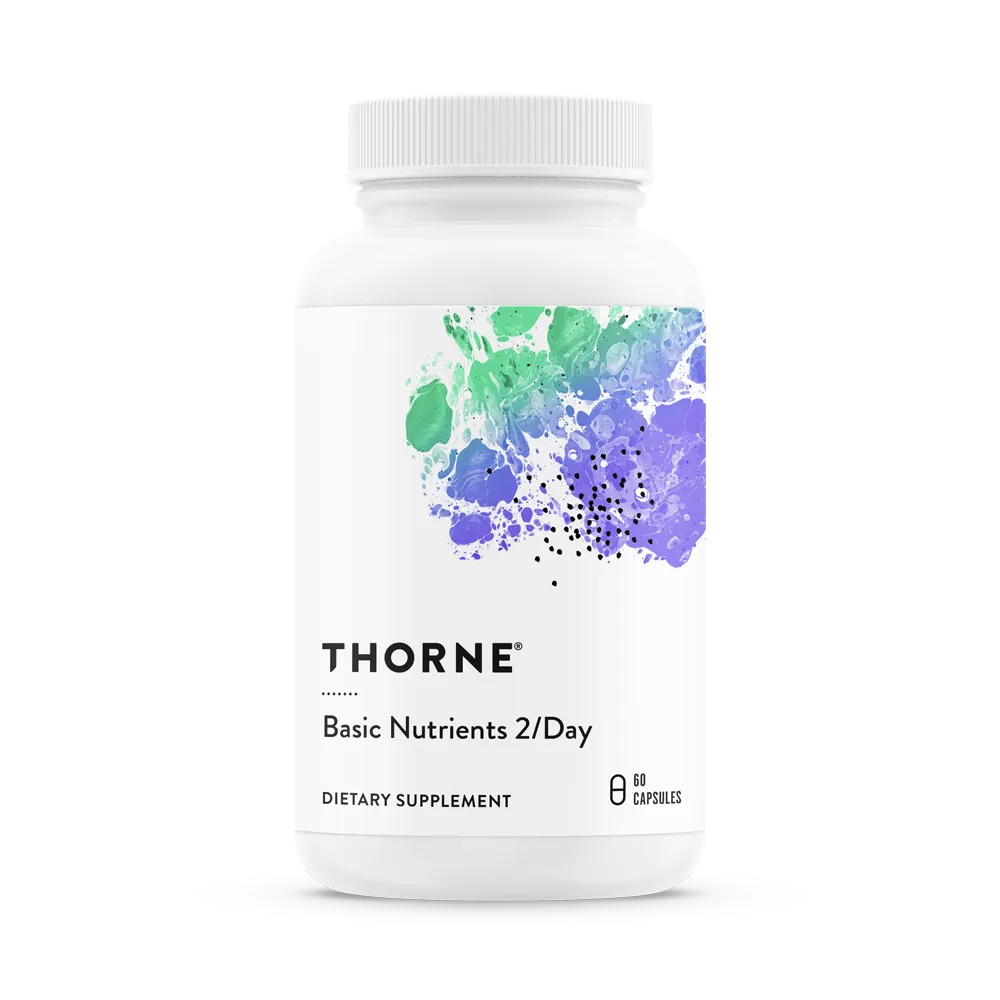
Basic Nutrients 2/Day earns the highest provisional score because its exact U.S. product appears in the NSF Certified for Sport directory and the full amounts are disclosed. It is not the universal “best multi.” High B-vitamin, selenium and chromium doses make it a product to fit around an identified need and the rest of the diet—not insurance to stack with every other supplement.
Score breakdown
| Area | Finding | Score |
|---|---|---|
| Formulation | Broad two-capsule formula; several high-potency doses | 20 / 25 |
| Transparency | Every active amount and form disclosed | 19 / 20 |
| Laboratory verification | Exact product and current lots in NSF sport directory | 20 / 20 |
| Safety and overlap | Clear label, but high-dose duplication requires care | 12 / 15 |
| Company accountability | Traceable product and certifier records | 9 / 10 |
| Value | Premium price partly justified by verification | 8 / 10 |
What the label actually provides
The reviewed U.S. label uses two capsules per day. It supplies vitamins A, C, D, E and K; a full B-vitamin group; zinc, selenium, chromium, copper, manganese, iodine and boron; and small amounts of calcium and magnesium. The label identifies nutrient forms rather than hiding them inside a proprietary blend. Folate is listed as 5-MTHF, vitamin B12 as methylcobalamin, and several minerals use glycinate forms.
That level of disclosure is useful, but form names should not become a shortcut for “better.” For most nutrients, the practical questions remain whether the person needs supplementation, whether the amount is appropriate and whether another product or fortified food already supplies it. A more elaborate chemical name does not turn an unnecessary dose into a necessary one.
Potency is the main decision—not a bonus
This is not a conservative once-daily formula built close to ordinary daily values. The two-capsule serving lists 50 mg thiamin, 80 mg niacinamide, 20 mg vitamin B6, 600 mcg vitamin B12, 200 mcg selenium and 400 mcg chromium, alongside 50 mcg vitamin D3. Those amounts do not automatically make the product unsafe, but they materially change the comparison. The correct question is whether the total intake from diet, fortified food, drinks and other supplements remains sensible.
The formula is also not a meaningful stand-alone source of the bulky minerals people often expect from a “complete” multi. It provides 20 mg magnesium and 52 mg calcium. That is a formulation constraint, not a defect unique to Thorne: fitting large mineral doses into two capsules is difficult. Buyers who need calcium or magnesium should not assume the multivitamin solves that problem.
Verification: what NSF does and does not prove
NSF Certified for Sport lists Thorne Basic Nutrients 2/Day as a U.S. vitamin product with named current lots and a two-capsule serving. That is stronger evidence than a manufacturer saying a facility is “quality tested.” It supports the identity of the exact product and the certification programme’s controls, including banned-substance risk management for athletes.
Certification does not prove that a healthy person will perform better, avoid illness or live longer by taking the product. It also does not transfer automatically to a different Thorne multivitamin, a bottle sold in another market or a lot that cannot be matched to the directory. The audit therefore rewards product-level verification while keeping outcome claims separate.
Who should be careful
Vitamin K can be relevant to anticoagulant management, and folate can matter in specific medication contexts. Pregnancy, diagnosed deficiency, malabsorption, kidney disease and other medical situations require a life-stage or clinician-directed decision rather than a generic high-potency ranking. The product contains no iron, which may suit many adult men and post-menopausal women but makes it an incomplete response to confirmed iron deficiency.
Athletes should also avoid treating the sport mark as permission to ignore dose. Banned-substance screening and nutritional appropriateness are different questions. NSF certification reduces one category of product risk; it does not determine whether the formula matches the athlete’s blood work, diet or medical history.
Value and alternatives
Thorne is a premium option. Part of the premium buys a two-capsule format, detailed forms and a traceable sport-certification record. If the buyer does not need a broad high-potency formula or is not exposed to sport-testing consequences, a conservative one-tablet product—or no multivitamin—may be better value. If one nutrient is the actual gap, a targeted supplement can be cheaper and easier to monitor than repeating twenty-plus nutrients every day.
ShreddedAF buying decision
Buy for: exact-product certification, complete disclosure and capsule convenience. Do not buy for: a guaranteed energy, immunity, performance or longevity effect. Check before purchase: the NSF listing, the exact bottle label, vitamin K relevance, and duplication with pre-workouts, fortified shakes, vitamin D, zinc, selenium or B-complex products.
No unverified award credit
No retailer badge, bestseller label or editorial award has been added to this score. A future recognition record will name the issuer, year and method and will still add zero audit points.
Evidence register
- Thorne official product and supplement facts.
- NSF Certified for Sport exact-product listing.
- NIH Office of Dietary Supplements: multivitamin/mineral supplements.
Source rule: The manufacturer establishes the reviewed market label and its own claims. The certifier establishes only the exact listing, standard and lots it publishes. General multivitamin research cannot validate every formula.
Official product page
No retailer or affiliate relationship is active on this page. Price, formula, serving size and certification can differ by country and variant.
Check the manufacturer page ↗