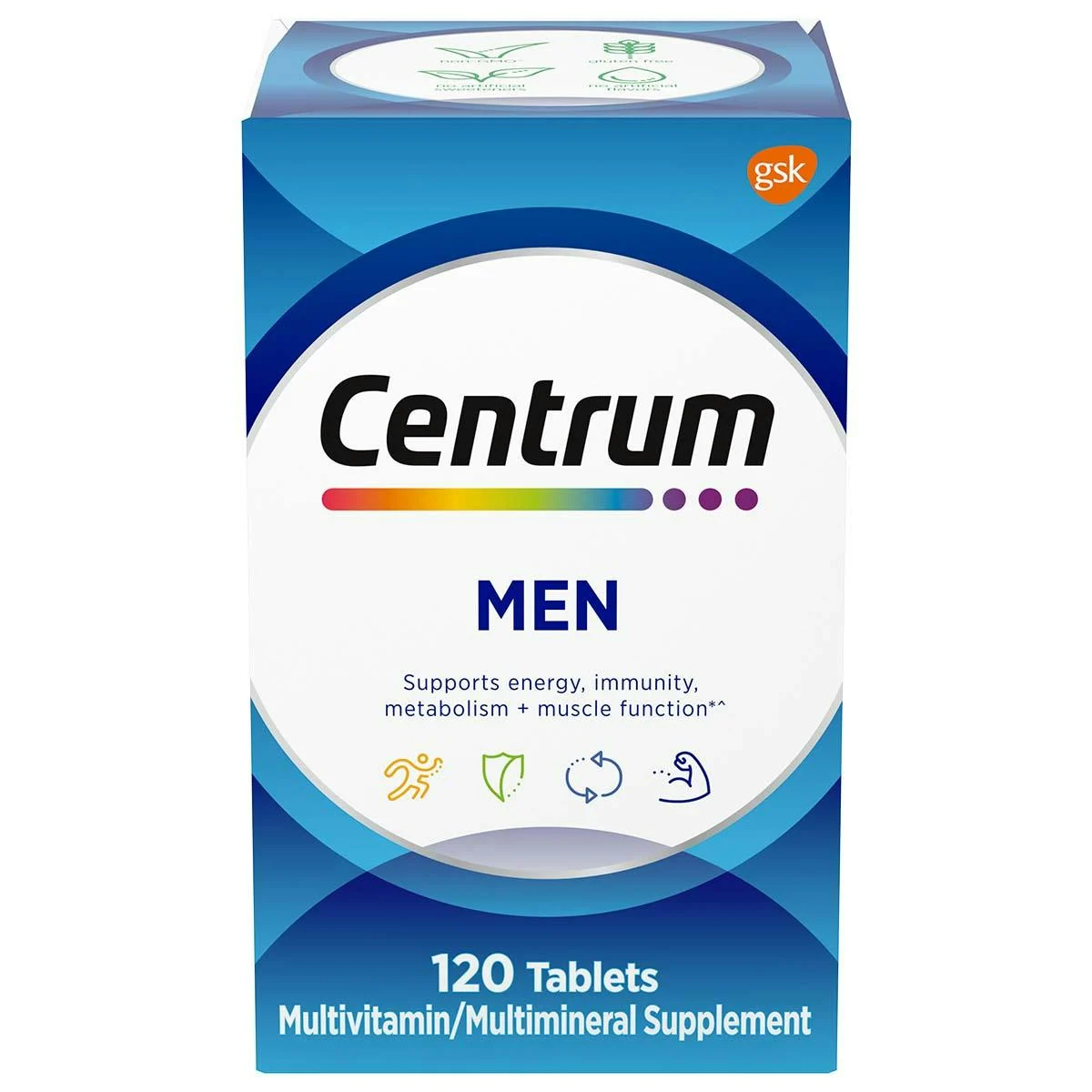
Centrum Men is the most defensible mainstream option in this first field: one tablet, a broad micronutrient label and a current NSF/ANSI 173 product listing. It is not a performance supplement and “men’s” positioning does not prove a special advantage over another well-matched basic multi. Its value is convenience and moderation, not transformation.
Score breakdown
| Area | Finding | Score |
|---|---|---|
| Formulation | Broad, comparatively conservative one-tablet profile | 19 / 25 |
| Transparency | Full market label and 24 micronutrients identified | 19 / 20 |
| Laboratory verification | Exact Centrum Men entry in NSF dietary listings | 17 / 20 |
| Safety and overlap | Moderate design; interactions and duplication still matter | 13 / 15 |
| Company accountability | Long-running product with regional documentation | 8 / 10 |
| Value | Low-friction mass-market pricing and availability | 6 / 10 |
Why this product scores differently from a sports multi
Centrum Men is built around a one-tablet daily serving and 24 named micronutrients on the current U.S. product page. The formula is positioned for general dietary coverage rather than maximal doses or a large ingredient count. That makes it easier to understand and usually easier to combine with an ordinary diet, although the exact amounts and ingredients still differ across countries.
The “Men” label should not be treated as proof of a unique outcome. Sex- and age-specific multis often change iron, vitamin D, calcium and other amounts to suit a broad demographic. They do not analyse the individual buyer’s diet. The useful comparison is the exact supplement-facts panel against the person’s likely gaps—not a pink-versus-blue packaging decision.
Formula strengths and blind spots
The product covers the common vitamin groups and a range of trace minerals in a single tablet. Centrum explicitly presents it as a supplement to a balanced diet and tells users not to exceed the suggested use. That is a more defensible boundary than marketing the tablet as a substitute for food.
Like most one-tablet multivitamins, it cannot carry large, meaningful doses of every bulky mineral. A buyer should read the amounts for magnesium, calcium and potassium rather than assuming “complete” means the tablet replaces food sources. The product also includes lycopene in its positioning, but the presence of one carotenoid does not establish a heart-health outcome for the finished tablet.
Third-party listing and what it means
NSF’s current dietary-supplement directory includes Centrum Men Multivitamin, tablet, at a one-tablet serving under NSF/ANSI 173. This is relevant product-level evidence and earns verification credit. It is not the same programme as NSF Certified for Sport, and ShreddedAF does not present the ordinary tablet listing as banned-substance certification.
That distinction matters for tested athletes. A general contents and manufacturing standard can strengthen confidence in product identity without answering every sport-specific contamination question. Buyers should match the exact format: Centrum gummies and 50+ formulas have separate identities and cannot inherit the score of this tablet.
Does a multivitamin improve health?
Evidence for multivitamins depends heavily on the population and the exact formulation. NIH notes that there is no standard regulatory definition requiring every multivitamin to contain the same ingredients or amounts. A trial of one formulation in older adults cannot prove that every product benefits every adult. Large trials also should not be reduced to a promise that the tablet prevents cardiovascular disease, cancer or cognitive decline.
The strongest practical case is narrower: a basic multivitamin may help fill dietary gaps when food intake is inconsistent or certain nutrients are difficult to obtain. It does not compensate for low protein intake, inadequate sleep, inactivity, smoking, excess energy intake or a diagnosed deficiency needing targeted treatment.
Regional labels are a real issue
Centrum is sold across Europe, North America and many other markets, but the bottle is not one universal formula. Nutrient amounts, permitted claims, tablet appearance and packaging can change. The U.S. page reviewed here must not be used to score a Cyprus or Greek bottle without checking that local label. This is especially important for iron and vitamin D, which are commonly adjusted by age, sex and region.
Value and alternatives
The one-tablet format has low friction and the brand is widely stocked, which can matter more for adherence than an elaborate premium formula. But value is poor if the buyer already receives the same nutrients from fortified cereal, drinks and another supplement. A food-first approach plus a targeted nutrient can be both cheaper and more precise.
ShreddedAF buying decision
Buy for: simple one-tablet coverage, a traceable general NSF listing and broad availability. Do not buy for: a direct muscle-building, energy-boosting or disease-prevention effect. Check before purchase: the local-market facts panel, iron content, vitamin K relevance and the total intake from fortified foods and other supplements.
No unverified award credit
No retailer badge, bestseller label or editorial award has been added to this score. A future recognition record will name the issuer, year and method and will still add zero audit points.
Evidence register
- Centrum Men official U.S. page.
- NSF official dietary-supplement listings: Centrum.
- NIH Office of Dietary Supplements: multivitamin/mineral supplements.
Source rule: The manufacturer establishes the reviewed market label and its own claims. The certifier establishes only the exact listing, standard and lots it publishes. General multivitamin research cannot validate every formula.
Official product page
No retailer or affiliate relationship is active on this page. Price, formula, serving size and certification can differ by country and variant.
Check the manufacturer page ↗